




Private credit is being marketed to UK investors as an "exclusive" opportunity once reserved for institutions. But when you look at what financial advisers are recommending to their clients, a different picture emerges.
Here's a puzzle. The UK investing industry is talking up a new “opportunity”. Higher yields than bonds. Lower volatility than equities. Steady income month after month.
Private credit used to be reserved for pension funds and endowments. Now, thanks to regulatory changes, it's coming to your ISA. You'd expect advisers to be queuing up to recommend it. But they're not.
According to a 2024 NextWealth survey of UK financial advisers, 80% have no plans to increase their clients' exposure to private credit or other private market assets. Fewer than one in five advice firms have any client money in these investments at all. Across the entire advised retail market, fewer than 2% of clients hold any private market exposure.
What do those four out of five professionals know that the brochures aren't telling you? Drawing on the largest independent study of private credit fund performance ever conducted, we'll look at what the data shows.
What is private credit?
Private credit is corporate lending outside the public bond market. Instead of a company issuing bonds that trade on an exchange, it borrows directly from an investment fund. The borrowers aren't household names, and there's no stock ticker tracking the value of your loan.Banks used to dominate this space. Then came the 2008 financial crisis.
After the crash, regulators tightened capital requirements for banks, making certain corporate loans less attractive to hold. Private credit funds stepped into the gap. From 2008 to 2023, most net growth in UK business lending came from non-bank sources, according to evidence submitted to the Loan Market Association.
Globally, the industry now manages over $3 trillion in assets. The UK is the largest market in Europe.
Proponents argue that because these loans don't trade publicly and you can't sell them easily, you should earn a premium for accepting that illiquidity. But does that premium really exist?
Why private credit feels so appealing
The attraction isn't about yield. It's about escape.Every investor knows the stomach-tightening moment of checking a portfolio on a bad day. The FTSE drops 3%. Your pension statement shows five figures wiped out. You're questioning every decision you've ever made. It doesn't matter that you know markets recover. The feeling is visceral.
Private credit promises relief from that cycle. Equity funds show jagged peaks and troughs. Private credit? Something closer to a gentle upward slope. Steady income. Stable valuations. No daily price swings forcing you to confront paper losses.
This isn't a coincidence.
Behavioural economists Daniel Kahneman and Amos Tversky demonstrated that we feel losses roughly twice as intensely as equivalent gains. A £10,000 drop hurts more than a £10,000 rise feels good. This asymmetry, which is known as loss aversion, shapes our financial decisions in ways we rarely notice. We'll go to considerable lengths to avoid seeing losses at all.
Private credit appears to offer exactly that: returns without the emotional punishment of watching your money fall.
Add the exclusivity factor and the appeal compounds. If pension funds and endowments have been investing this way for decades, surely there's something to it. The velvet rope made it look special. Now the rope is being unclipped.
But here's the question: is the smoothness real, or is it how the numbers are reported?
What 900 private credit funds tell us about returns
The largest independent study of private credit performance found no evidence that investors are compensated for giving up liquidity.In July 2024, researchers at Dimensional Fund Advisors published an analysis covering more than 900 private credit funds spanning 1980 to 2022. The data came from the MSCI Private Capital Universe, sourced directly from the institutional investors who put money into these funds.
The researchers found that, when compared against publicly traded high-yield bonds, the average private credit fund slightly underperformed.
They used a measure called KS-PME, which compares private fund returns to what you'd have earned investing the same cash flows in a public market benchmark. A score of 1.0 means identical performance.
Private credit scored 0.97 against the Bloomberg US Corporate High Yield Index. In practical terms: negative alpha of 0.55% annually relative to high-yield bonds. You'd have been marginally better off in a fund you could sell any day of the week.
"There is no 'illiquidity premium' for the average private credit fund relative to public high yield," noted Mamdouh Medhat, one of the study's authors.
High-yield bonds are the fair benchmark. Both involve lending to below-investment-grade companies. Both carry meaningful credit risk. One trades daily and costs a fraction in fees. The other locks up your capital for years.
Private credit does outperform investment-grade bonds. But that's the wrong comparison. You're taking credit risk. You should be compensated for it. Against comparable public credit, you're not.
The stability you see isn't the risk you're taking
The smooth return charts aren't evidence of lower risk. They're a product of how private assets are valued.Public bonds and shares are priced continuously, but private credit works differently. Funds value their holdings quarterly, not daily. And because these loans don't trade on an exchange, there's no market price to anchor to. Managers estimate what the loans are worth based on models and judgment. The result? A return series that moves in gentle steps rather than sharp swings.
Cliff Asness, co-founder of AQR Capital Management, coined a term for this: volatility laundering. The underlying risk hasn't disappeared. It's been smoothed out of the reports.
The Dimensional study shows how this works. Before 2007, when fair value accounting rules were less stringent, public bond market factors explained relatively little of private credit's quarterly returns. After the rule changes, those same factors explained between 60% and 90% of the variation.
Once valuations became more rigorous, private credit started moving in step with public markets. The diversification benefit that appeared so attractive was partly an artefact of stale pricing.
Think of it like stepping on the scales once a quarter and congratulating yourself on stable weight. The daily fluctuations still happened. You chose not to look.
Even if some funds win, can you pick them?
The averages hide a wide spread of outcomes. And in private markets, you can't buy the average.The Dimensional study found that private credit shows less dispersion between managers than private equity or venture capital. But "less" is relative.
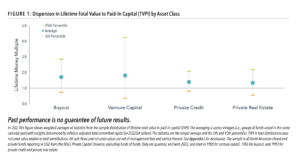 Private credit shows less spread than venture capital or buyout, but the gap between the best and worst funds is still the difference between losing money and more than doubling it. Source: Dimensional Fund Advisors, 2024
The chart above shows why averages mislead. In private credit, the average fund returned 1.39 times investors' money. But the fifth percentile returned 0.81 times. That's a loss of nearly 20% of your capital. The 95th percentile delivered 2.08 times.
The gap between a poor fund and an excellent one is the difference between losing money and more than doubling it. In public markets, a low-cost index fund solves this. Buy it and capture the market return. No selection skill required. In private markets, that option doesn't exist. Every investment is an active bet on a specific manager.
Remember, you're not accessing "private credit returns". You're accessing one fund's returns. And you're making that choice with far less information than the institutions who've been doing this for decades.
The due diligence required to evaluate a private credit manager is substantial. Even professional allocators get it wrong. The assumption that retail investors or their advisers will reliably identify top-quartile funds? Optimistic at best.
What you're paying for "exclusive" access
The fee structures mean the maths works against you before the first loan is made.Typical private credit funds charge management fees of 1.5% to 2% annually, plus performance fees that can reach 20% of returns above a hurdle rate. For retail investors accessing these strategies through feeder funds or platforms, additional layers often apply. Platform charges. Wrapper fees. Advice costs on top.
Compare that to a high-yield bond ETF. The iShares £ High Yield Corp Bond UCITS ETF charges an ongoing fee of 0.50%. Some alternatives cost even less.
The difference between 2% and 0.5% might sound modest in percentage terms. Over a decade, it compounds into a significant portion of your returns.
Here's what makes this particularly pointed: the Dimensional study measured returns net of fees and carried interest. The slight underperformance against high-yield bonds already accounts for what private credit managers took. Before costs, the underlying loans presumably delivered more. After costs, you received less than a cheap public alternative would have given you.
The FCA's Consumer Duty rules require advisers to demonstrate that products offer fair value. When an investment charges multiples of a comparable alternative and delivers similar or worse outcomes, that conversation becomes awkward.
Exclusivity has a price. The question is whether you're getting anything for it.
What happens when you need your money back
The liquidity terms are designed around the asset, not around your life.Long-Term Asset Funds, the UK's new vehicle for bringing private credit to retail investors, require a minimum 90-day notice period for redemptions. Many also cap how much can be withdrawn each quarter, often at 5% of the fund's value. If you need your capital back quickly, you may be waiting months. If many investors want out at once, longer.
UK investors have seen this film before. In 2016, after the Brexit referendum, several open-ended property funds suspended redemptions when too many investors tried to exit simultaneously. The same happened in March 2020 during the pandemic sell-off. Investors who thought they owned liquid funds discovered otherwise at precisely the moment liquidity mattered most.
Listed investment trusts that hold private credit at least trade daily on the stock exchange. But during stress, they often trade at steep discounts to their stated asset value.
Liquidity comes at a cost.
The irony is that you're accepting these constraints for returns that, on average, don't compensate you for them. You've given up flexibility. What did you get in exchange?
How to get similar returns without locking up your money
If you want exposure to corporate lending at higher yields, you already have options that don't require sacrificing liquidity or paying premium fees.High-yield bond funds invest in the same basic proposition: lending to companies with below-investment-grade credit ratings in exchange for elevated income. The difference is that you can sell your holding tomorrow. A diversified high-yield bond ETF costs a fraction of a private credit fund and, according to the Dimensional research, has delivered equivalent returns over the long term.
The evidence-based approach is less exciting but more reliable. A diversified portfolio of low-cost bond funds, appropriately weighted for your risk tolerance, captures the returns available from credit markets without the complexity.
The boring solution often works best.
Questions to ask before you invest in private credit
If an adviser recommends private credit, here are three questions you need to ask.First: what's the all-in cost, including every layer of fees? Management fees, performance fees, platform charges, advice costs. Compare the total to what you'd pay for a high-yield bond fund.
Second: how does the fund's expected return compare to that cheaper alternative after all costs are deducted? If the answer is vague, that's informative.
Third: what exactly happens if I need my money back? Find out the notice period, the redemption caps, and the circumstances under which withdrawals might be suspended, and get it in writing.
Remember where we started. 80 percent of UK financial advisers aren't recommending private credit to their clients. Now you understand why.
The exclusivity was never about quality. It was about operational complexity and high minimums. Those barriers kept ordinary investors out. They didn't make the returns any better.
If you'd like to discuss how evidence-based investing fits within your broader financial planning, we're happy to help. You can book a consultation with an adviser to talk through your options.